Sunday, March 20, 2011

Sickle Cell Disease

 Paul Williams, a baritone singer in


The Temptations, a choreographer, and a victim of sickle cell disease.


Sickle cell disease is a recessive genetic blood disorder with overdominance, characterized by red blood cells that are in an abnormal, rigid, crescent shape.

1910-Noted by Dr. James B. Herrick, a patient from the West Indies had an anemia characterized by unusual crescent shaped red cells.
1927-Hahn and Gillespie showed that sickling of the red cells was related to low oxygen levels.
1940-Sherman (a student at Johns Hopkins Medical School) noted that low oxygen altered the structure of the hemoglobin in a molecule.
1984-Bone marrow transplantion in a child with sickle cell disease produced the first reported cure.

Symptoms include:
  • shortness of breath
  • dizziness
  • headaches
  • coldness in the hands and feet
  • jaundice (yellowish color of the skin or whites of the eyes)
  • Common symptom of sickle cell disease crisis: sudden pain throughout the body
Causes:
  • inherited, has two sickle cell traits, one from each parent
  • those that only have one sickle cell trait and one normal gene has sickle cell trait. They produce sickle cell genes and normal genes, but usually live a normal life.
  • single letter change in DNA, which alters one amino acid in the hemoglobin protein
Diagnosis:
A simple bloodtest during any time in a person's life will show if that person has sickle cell disease. All of the states in the United States make testing for sickle cell disease in an infant screening program mandatory.

Treatment/Cure:
Bone marrow transplant, although used only in select cases, prove to be about 85% successful in curing sickle cell disease. The only other treatment is over the counter medicines given as an infant and is continued throught the person's life.

Prevention:
There is no prevention of sickle cell disease. It is a trait passed down through generations.

Current Research:
The main research currently being conducted by the Center For Sickle Cell Disease is different treatments.

Sickle Cell support foundation: http://sicklecelldisease.org/
Sickle Cell Disease Association of America

Sources:


Thursday, December 17, 2009

Journey To The Center Of The Earth

After watching Journey to the Center of the Earth, I learned that muscovite is very thin rocks. The slightest change of weight will make it break. I learned that magnesium is very flammable. Lastly I learned that adventures can be very dangerous.
Three things that I learned were not really true in Journey to the Center of the Earth are that the glowing blue extinct birds are not actually glowing, dinosaurs are not still alive like shown in the video, and you cannot go to the center of the Earth.

MY FAVORITE TOPIC!!!!!!!!!!!!!!!!!!


My favorite topic in Earth Science was astronomy. I liked learning about black holes, and I wish I could have done black holes for our astronomy choice projects. I think that it is pretty cool that anything that falls into a black hole is instantly crushed. I also think it is kind of interesting that stars with three solar masses can turn into a black hole. The fact that no light can escape a black hole is simply fascinating. =D =D =D =D =D =D

Monday, December 7, 2009

Big Bang

I think the universe was just a great big open space of nothingness. You could not see a thing. The universe went under an initial inflation that was very quick and was almost instantly how we see it today. However, this is just a theory. =D

Optical Detection

Four ways that astronomers can detect extrasolar planets are by radial velocity, astrometry, transit method, and optical detection.

In optical detection you can block out the star's glare using a physical mask called a coronograph. The cornograph hides everything except for the stars corona so you can see the other planets.
I have looked over many websites and I have not found any information that tells me how many extrasolar planets have been found through optical detection. I honestly cannot really even find anything about optical detection.

Monday, November 23, 2009

Charon


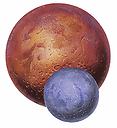
I like Pluto's moon Charon because it looks pretty cool. I also like it because it is part of Pluto, and I think Pluto is pretty cool because it is a puppy. However, Pluto is also my favorite planet. If you don't like Charon too then you hate puppies because the planet that Charon moves around's name is Pluto and Pluto is a puppy.

Friday, November 13, 2009

Astronomy

Black holes are the ends of starsw that are at least ten to fifteen times as massive as the Sun! If a star that is that big goes through a supernova explosion, it is possible that it will leave behind a rather large burned out stellar remains. Without any kind of outside forces to go against the gravitational forces, the remains will collapse on itself. Eventually the star will collapse to zero volume and infinite density. As the density increases, the path of the light rays that come from the star are bent and are wrapped to a point where they cannot be unwrapped. The star is called a Black Hole because no light escapes after the star reaches this infinite density.

Worm holes are supposedly short cuts through space.

Thursday, November 12, 2009

Global Warming

Global warming is the increase in the temperature of the earth's surface due to the emission of greenhouse gases from human activity. I do believe in global warming because glaciers are melting, sea levels are rising, cloud forests are drying, and all in all, the temperatures are much higher than they have been in the past. Three pieces of evidence that say global warming is not happening is that Antarctica is getting colder, not warmer, polar bear numbers are increasing, oceans are cooling, and Mars and Pluto are warming too.

Condensation


Some examples of condensation nuclei are water gathering on a cold glass of water, water gathering on the mirror during a shower, water gathering on the grass (dew), the mist on the windows on cold mornings, and the windows of a car fogging up.

Air Masses

The four main types of air masses are cT, mT, cP, and mT. C stands for continental which is dry, T stands for tropical which is warm, M stands for maritime which is wet, and P stands for Polar which is cold. I think the maritime tropical is most likely to bring hurricanes because they are off the coast, and the are warm and wet. The air mass that I think would most likely bring a drought is the continental tropical because it is warm and it is dry. I think that continental polar is most likely to bring lake-effect snowstorms because it is very dry and cold, so it wouldn't melt snow. =D The arctic air mass has pretty much the same characteristics as polar, except it is much colder with lower dew points. Highland occurs in regions with large elevation changes over short distances.

Recycling.

I also agree that recycling is a good thing, and i think we should recycle glass because every tone of glass recycled saves the equivalent of nine gallons of fuel oil needed to make glass from virgin materials. I think it is better to recycle products then to reuse them because recycling could make it into something way more important then whatever creative and odd ideas you can think of to reuse them. People of Fayetteville can recycle by using their blue cans right, by putting items that can be recycled into them. The closes recycling center to my house is 7581 Lowell Harris Road, which is the Cliffdale Site. Nine things that can be made from plastic after being recycled are: bottles, shower stalls, recycling bins, scouring pads, paint brushes, industrial strapping, drainpipes, plastic lumber, flowerpots, and more. Five things metal can be turned into once it has been melted down are: cans, automobile parts, siding, appliances, building materials, and more. Something I can do to promote recycling is actually start to use my recycling bin.

Tuesday, November 10, 2009

Pluto


I think Pluto is not a planet. It is a dog. =D In all seriousness I think Pluto is not a planet because there was another planet discovered that was much larger than Pluto, and astronomers realize they had to reconsider their definition of a planet. They decided that a planet must fulfill three criteria, which was that a planet must orbit the sun, it must have enough mass to pull itself into spherical shape, and it must have cleared out the other objects in its orbit. So, both Pluto and Xena were named dwarf planets.

Wednesday, November 4, 2009

Monsoon (by Tokio Hotel)

1. A Monsoon is the seasonal wind shift.

2. Two main causes of a Monsoon is the Bermuda High and the Thermal Low.

3. Monsoons prevent droughts and some people like the rain. =D

4. Monsoons bring floods.

Friday, October 23, 2009

Hurricane Alicia


I chose Hurricane Alicia because it reminds me of Alice In Wonderland and that is the newest movie from Tim Burton. =D Hurricane Alicia was rated as a category 3 hurricane. Alicia formed on August 15th, 1983. It was fromed over the northern center of the Gulf of Mexico, and moved slowly towards the west and northwest while getting stronger on the 16th and 17th. This movement brought Hurricane Alicia to the western end of Galveston Island, Texas on August 18. Alicia moved into Nebraska on the 21st. The Coast Guard in Galveston reported sustained winds of 96 miles per hour with gusts up to 125 miles per hour.


Alicia was resposible for 21 deaths and about $2 billion dollars in damage in the United States.


Friday, October 16, 2009

Greenhouse Effect

IR Radiation is also known as heat or infrared radiation. The three main greenhouse gases are carbon dioxide, methane and water. I think the greenhouse effect is a bad thing. It gives to much heat to earth, and it raises the sea levels which helps contribute to floods.

Thursday, October 8, 2009

2nd quarter blog grade

I believe I deserve a grade in the 90s again. I believe this because I have once again done very well on my blogs and I turn them in mostly on time, except for that one day that the computers were being really mean to me. So there was blog post number 6 that is late, but thats thanks to the laptops being against me. Other than that I believe I deserve in the 90s because I don't really have any grammar mistakes, and I use words correctly and answer the questions completely. =]

Wednesday, October 7, 2009

Pacific Ocean

The Pacific Oceans natural resources include: oil and gas fields, polymetallic nodules, sand and gravel aggregates, placer deposits, and fish. Polymetallic nodules, also called manganese nodules, are rock concretions on the sea bottom formed of concentric layers of iron and manganese hydroxides around a core. Sand and gravel aggregates provide cement and concrete. Placer deposits are accumulations of valuable minerals formed by deposition of dense mineral phases in a trap site. Everybody of course, should know what oil and gas fields and fish are, I think its somewhat obvious.

Periods

The periods from oldest to youngest is Cambrian, Ordovician, Silurian, Devonian, Carboniferous, Permian, Triassic, Jurassic, Cretacious, Tertiary, and Quaternary.
count
out
seven
devious
cruel
people
today
john
cut
the
queen

Friday, October 2, 2009

Desiree Holmes, slides 1-6

Friday, September 25, 2009

Tree Rings

As you can see, this tree is about 29 years old.
Scientists can tell the age of a tree by looking at the rings because not only do trees grow taller, they grow thicker also. Everytime the tree grows thicker, it creates a new ring. This is important because it tells you how long the tree has been alive, and sometimes it shows things that have happened to the tree throughout its life. This would be an example of absolute dating because each ring represents a certain amount of years.